Can they explain the behavior?
Ask them to trace the code, surface its assumptions, and explain how a specific issue would affect a real user.
FREE CODE REVIEW ASSESSMENTS · FOR HIRING TEAMS
Give candidates code with issues you’ve deliberately prepared. See what they catch, how they explain it, and which changes they would make before shipping.
Free for hiring teams. Free for candidates.
Upload your repository, share invitations, and review submissions—all for free, forever.
async function getInvoice(req, res) { const invoice = await findForAccount( req.params.id, req.user.accountId); const invoice = await findById(req.params.id); return res.json(invoice);}A POLISHED SUBMISSION IS ONLY PART OF THE PICTURE
A polished take-home leaves you with another task: work out how much the candidate understands. You have to explore their implementation before you can meaningfully challenge their decisions.
Start with code you already know. Prepare the bugs and structural problems, record private reference notes, and give candidates a focused review task. Their findings become the starting point for your interview.
MAKE THE REASONING VISIBLE
You know the intended behavior and the deliberate problems. Use that shared context to ask specific questions about the candidate’s reasoning.
Ask them to trace the code, surface its assumptions, and explain how a specific issue would affect a real user.
See whether they distinguish a blocking issue from a preference. Ask which fix they would make first and what trade-offs it introduces.
Change a requirement or challenge an assumption in the follow-up interview. Ask how they would adapt their recommendation and explain it to the author.
HOW IT WORKS
Prepare the issues, record your expectations, and observe their review. Then discuss the reasoning behind their findings.
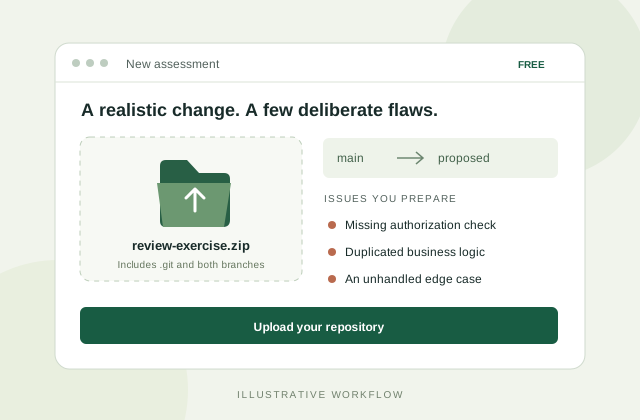
Prepare a test repository with bugs, structural problems, or questionable design choices in the proposed branch. Upload a ZIP containing its .git folder and both branches, then preview the comparison.
Or start from a public template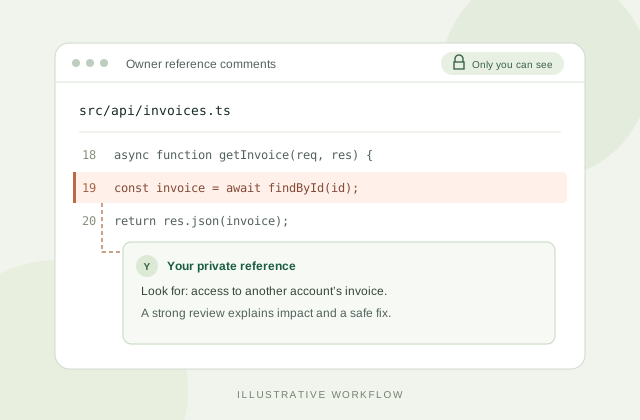
Mark problematic lines with private reference comments. Note the issue, why it matters, and what useful feedback would address. Candidates see the code, while your reference notes stay private.
Finalize the comparison before sending invitations.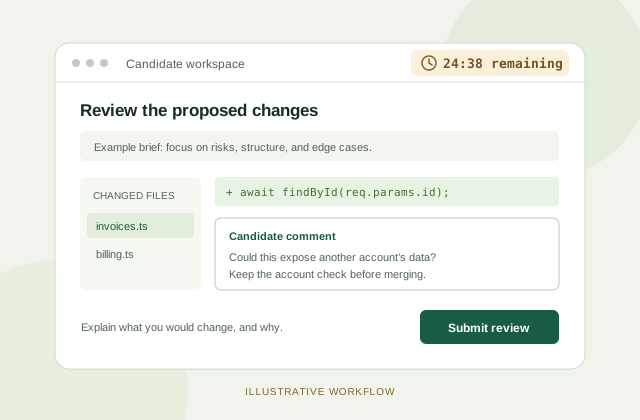
Set a time limit—for example, 30 minutes—and share individual invitation links. Candidates review the changes, leave comments, and submit their findings with a visible countdown.
The review closes automatically when time runs out.Read their comments against the issues you prepared. Ask why an issue matters, how they would fix it, and what would change their recommendation. You already know the code, so you can focus the conversation on their understanding.
YOUR CODE. YOUR ENGINEERING STANDARDS.
Choose a change that reflects the role: an API refactor, a payment flow, or a frontend state update. Give every candidate the same context and use your private reference comments to keep the discussion focused.
Public templates offer a starting point. Your own scenarios and review expectations make the exercise relevant to your team.
BUILT FOR THE AI CONVERSATION
AI can help write code. It can also help review it. Set clear expectations about tool use, then ask candidates to explain and defend their feedback. This assessment gives you something concrete to discuss; it does not prove who produced an answer.
THE PRACTICAL DETAILS
Yes. Set a time limit for the exercise, such as 30 minutes. Candidates see a countdown while they review, and the review closes automatically when time runs out.
Yes. The complete core code review workflow is free forever for hiring teams and candidates. Upload your Git repository ZIP, create an assessment, share individual invitations, and inspect candidate feedback without paying. Candidates can review code, save comments, and submit their work for free too.
We offer powerful AI analysis through optional paid plans. The core platform—uploading repositories, creating assessments, inviting candidates, and reviewing their comments and submissions—will remain free forever. You do not need a paid plan to run a code review assessment.
They sign in, accept their individual invitation, and review the proposed code changes in their browser. They can explore the diff and the base and proposed versions of changed files, save comments on lines or ranges, and submit an optional summary and decision. They can resume their review before submitting.
Yes. This is not an AI detector or a proctored assessment. Set your tool-use expectations in the task instructions. The review gives you specific comments and decisions to discuss afterward: ask the candidate to explain a risk, defend a recommendation, or describe what would change their mind.
You can browse public templates and clone one into your own independent assessment, or upload your own Git repository ZIP. Add task instructions, choose the base and proposed branches, preview the comparison, and save private reference comments before inviting candidates.
Upload a ZIP containing a real Git repository, including its .git folder and both branches. The assessment compares the base branch tip with the proposed branch tip. A standard source-only GitHub download ZIP will not work. GitHub account integration is not required.
Your hiring team does. You can inspect saved comments in their code context, including work in progress, and read the submitted summary and decision. Private reference comments help you record what to look for. The product does not automatically grade, rank, or make hiring decisions.
No. Owner reference comments are private. Each candidate has a separate session and their own comments. Once submitted, that candidate’s review becomes read-only. Finalize the branch comparison before inviting people, since existing sessions follow the assessment’s selected comparison.
MEET YOUR NEXT CODE REVIEWER
Upload a ZIP. Invite your candidates. Review their feedback. All for free, forever.
© 2026 CASESTUDYPREP.AI RIGHTS RESERVED. v.1.34
This drops the account check. Could a signed-in user fetch another account’s invoice by changing the ID?
Keep the account-scoped lookup and add a test for cross-account access before merging.